Film Scene Hall of Fame #1
Reply

Think of every stock photo and stereotype about 1950s and 1960s suburban America. Think about Dick and Jane reading books, gingham aprons, milk served in pitchers and cookie jars.
Think about kids lined up for polio shots, Ed Sullivan, and service station attendants wearing well-pressed uniforms.
It was not a complete fiction. I know. I was there.
But also – while you’re at it — think of whiteness, of blocks and blocks of white families doing white things, opening mail boxes to find magazines filled with stories about patio furniture and backyard BBQs and vacations in station wagons. And think of house after identical house, where any internal emotional turbulence or troublesome external social ferment could always be neatly hidden beneath the veneer of Cub Scout meetings, bake sales, and summer vacations.
Think of a whiteness so relentless that it was both everywhere and nowhere, pervasive yet so taken for granted that it could hardly be noticed. Imagine a place where you could come of age without ever seeing a black person in the flesh.
And I then I remembered the day that this issue of long-defunct Life Magazine arrived in our mail box.
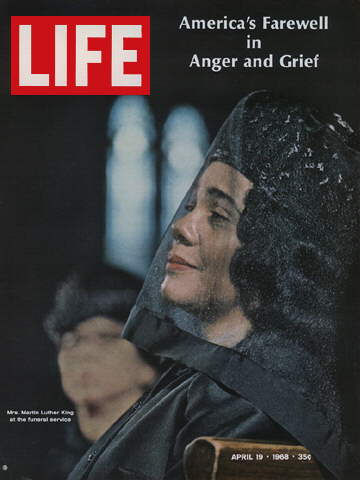
Martin Luther King had been assassinated two weeks before. The event stunned and horrified us. I was fortunate to have parents who had taught my sisters and I about racial injustice. I still treasure the memory of one of my father’s finest moments when, hearing me utter an offensive racial remark at the age of eight, followed the charming fashion of the day by filling my mouth with a bar of ivory soap.
But we lived where we lived, and this magazine arrived like a live grenade. Martin Luther King, Jr. was dead, and now we had to look his wife straight in the face. We had to see her grief. Even worse, we had to contend with her serenity in the midst of the horror. We had to imagine her husband with his eyes closed, stilled and silenced.
I know that sometimes, in our zeal to construct compelling life narratives, we look back and overstate the significance of events. But I also know that nothing was the same after that magazine arrived. Our comfortable world had been pierced by the reality that rifles could silence a man’s passion and indignation.
There is no dramatic or profound ending to this story.
Nothing magic happened.
Miraculous revelations of tolerance were nowhere to be seen.
There was no justice and nothing was flowing like a mighty stream.
Our neighborhood stayed the same. Most people remained remarkably skilled at maintaining a willful blindness that obscured the anger and ferment brewing in distant places.
But never again could we claim, at least not with a straight face, that we knew nothing of that other world where guns were fired and justice denied. It arrived on the cover of a long-defunct magazine, and somehow we sensed that the dream deferred, festering like a sore yet so invisible in our blindingly white world, would soon explode.
So, our President – a barely human mixture of evil, ignorance and cruelty – has now issued his instructions for the troops being sent to our southern borders to meet the sinister immigrants he is using to mobilize his xenophobic supporters.
What sayeth our master of military strategy? Rocks are to be considered firearms and met with appropriate force. And while it is unclear if these are actually the rules of engagement given out by military leaders, his statement does send a confusing and completely unhinged signal to troops entering such a fraught situation.

If this “rifles against rocks” strategy is something you find acceptable, you can stop reading here and switch to a site more comfortable with the perverse idea that deadly force makes perfect sense in the epic battle between privilege and human suffering.
But if the thought of armed troops in battle against rock-throwing children makes you sick to your stomach, stop whatever you are doing and see Kieran Fitzgerald’s shattering and cautionary film The Ballad of Esequiel Hernandez. Released in 2007 and originally broadcast on POV, PBS’s premier showcase for award-winning documentaries for 30 years, the film details the 1997 killing by US troops of an 18-year old US citizen herding his sheep near the border.
My point? All manner of tragedy is possible when the lethal tools of excessive force are locked and loaded and under the direction of a maniacal, narcissistic commander in chief who actually seems to enjoy terrorizing the desperate, the hungry, the homeless.
Mr. Tough Guy. Pathetic. Despicable.
No matter what problems you are dealing with, the people at the National Suicide Prevention Lifeline want to help you find a reason to keep living. By calling 1-800-273-TALK (8255) you’ll be connected to a skilled, trained counselor at a crisis center in your area, anytime 24/7.


Kathy’s mother: Kathy, where were you?
Kathy: I went to pick flowers.

For more than 10 years starting in the late 1980s at Hunter College, I taught a course called HIV/AIDS in Media and Culture in Hunter College’s Department of Film and Media Studies. Speakers included Maria Maggenti, one of the founders of ACT-UP and outstanding filmmaker, Bree Scott Harland of the PWA (People With AIDS) coalition, Rodger MacFarlane, the first paid executive director of the Gay Men’s Health Crisis (GMHC), and Craig Davidson, one of the founders of GLAAD and its first Executive Director from 1987 – 1990. Students in the class were among those attending Craig’s memorial service at St. Peter’s Church on Lexington Ave. when he died of HIV-related symptoms.
We examined many of the first attempts to make sense of the plague in theater, talk television, film, art, and print and television news. Highlights included Terrence McNally’s brilliant television drama Andre’s Mother, Tina Di Feliciantonio’s groundbreaking film Living With AIDS, Keith Haring’s posters for ACT-UP, and the early episodes of the Phil Donahue Show that gave activists like Larry Kramer, Peter Staley, Ann Northrup and others some of their earliest wide exposure on national television. The early cultural criticism of Douglas Crimp around HIV/AIDS was invaluable.
One day in 1990, taking the #6 train up to Hunter, I discovered that the New York City health department had begun to use comics, drawing on the fotonovela tradition, to deliver public health messages about safe sex, condoms and more.
Perhaps some of you recall the saga of Julio and Marisol, whose love life amidst a plague played out in the NYC subway system. Beyond the brilliant use of comics, the series was especially important given that it was accessible to Spanish speakers and that the risk to Marisol was dealt with so prominently.
Risk to Marisol? It’s hard to believe, but in the early days of the plague all sorts of self-appointed and media-anointed “experts” were appearing on television talk shows minimizing the risk of HIV to women. I suppose they were perversely comforted by reinforcing the homophobic narrative that gay men somehow deserved to be infected. Even more problematic was the fact that these “experts” often included conventionally trained physicians and scientists who were making inferences from data that were both astoundingly wrong and incredibly dangerous.
Those who don’t know the story of Julio and Marisol might be interested in these articles. The whole campaign ended suddenly, about 5 years later, in a sad example of what can happen when commercial considerations come up against an urgent public health concern. The new MTA policy of allowing advertisers to buy every available slot in a single subway car largely eased them out.
Like most early HIV-AIDS culture, people of color were latecomers to the dominant media narrative. This negligent invisibility, grounded in racist notions of whose lives mattered the most, is also part of the context in which Julio and Marisol surfaced.
But before their story ended, Julio and Marisol served as frontline HIV-AIDS educators, and even – around the time the series was about to end in 1995 – confronted death without flinching.
Damn, what a nightmare.
This morning I was thinking about how quickly our culture anoints heroes. Some unspeakable act occurs and, in a desperate attempt to find a savior, heroes are selected and honored while the accused are demonized. In our infinite patience, we do this so quickly that medals are often presented before we even know exactly what the hero did.
Isn’t this backwards?
Doesn’t the magnitude of an act of courage only become clear with the passage of time, when we can look back and see the historical context in which an act was truly selfless? On the other hand, doesn’t time also occasionally reveal the self-interest and even selfishness that might have been the actual motive for an act initially hailed as courageous?
Here is my favorite scenario for what makes a genuine hero: A modest, decent person does something quintessentially selfless without regard for personal safety. Some people pay attention, but — for a whole host of reasons — the act takes place below the radar of public attention. Maybe the hero isn’t especially desirable. Maybe he or she is a member of a despised group. Or maybe the act itself is such a violation of current values that it is reviled rather than admired.
But then, as time passes, the magnitude of the act – the extent to which it fearlessly transcended the conventions of the moment — slowly becomes clear. And decades later we ask ourselves: How did anyone have the guts to do that?
And so I present my choice for a hero.
The 1955 murder of Emmett Till was a seminal moment in the history of the civil rights movement.Till was a 14 year-old African American from Chicago visiting his family in Mississippi. When he violated the unwritten laws of segregation by talking to a white woman, he was abducted and brutally murdered. Photographs of his open-coffin funeral, revealing an unspeakably savage beating, were widely circulated. Emmett’s mother Mamie became a passionate and eloquent voice for social justice.
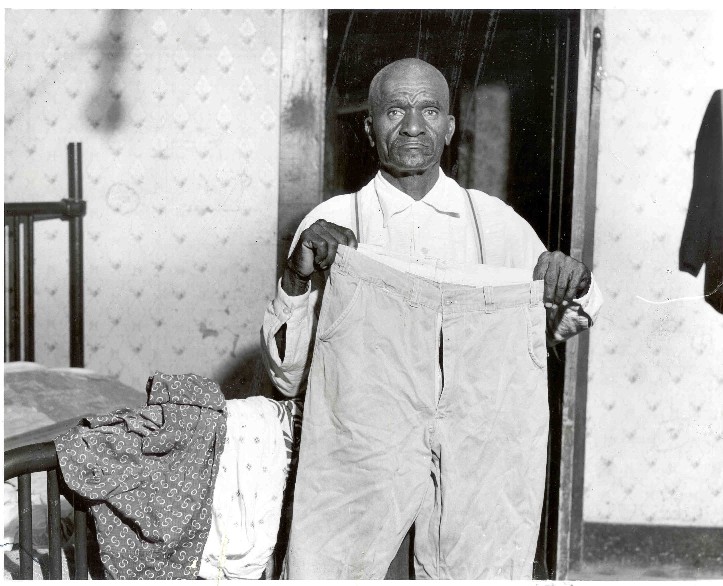
My hero, though, is Mose Wright. Mr. Wright was Emmett’s uncle and a witness to the abduction. When two men were accused of the crime, Wright chose to be a witness at the trial and personally identified the two white defendants. At the time, observers at the trial could not recall another example of a black man testifying against a white defendant. Wright moved to Chicago, but once more – ignoring warnings that he would be killed –returned to testify against his nephew’s killers. He never flinched or hesitated.
There’s a lot more to the story. The defendants were acquitted, yet later admitted the killing to Look Magazine for $4000.
And even more, many year later.
Wright died at the age of 83 in 1973.
There is courage. There is heroism. There is selflessness. There is sacrifice. There is near-greatness. There is greatness.
And sometimes, there is a Mose Wright.

Yesterday, waiting in suburban New Jersey for a train, I looked up and saw the scene below on the telephone wire looming right above the train platform. I knew that the birds would disperse as soon as the train arrived, and in fact the lights of the train were getting close. I quickly snapped this photo.
It’s not that I needed any proof of Alfred Hitchcock’s brilliance. But yet again I was reminded that — for me at least — there has never been a filmmaker who so skillfully and insidiously plays with my fears, anxieties, and obsessions, not to mention leaving haunting, mental residue that lasts for decades.
It was Tuesday, September 19, 2017. And, just for a moment, I felt like I was living in the village of Bodega Bay, California depicted in Hitchcock’s The Birds
 .
.
– Thomas Hobbes (1588-1679)


THE SECOND COMING
Turning and turning in the widening gyre
The falcon cannot hear the falconer;
Things fall apart; the centre cannot hold;
Mere anarchy is loosed upon the world,
The blood-dimmed tide is loosed, and everywhere
The ceremony of innocence is drowned;
The best lack all conviction, while the worst
Are full of passionate intensity.
Surely some revelation is at hand;
Surely the Second Coming is at hand.
The Second Coming! Hardly are those words out
When a vast image out of Spiritus Mundi
Troubles my sight: a waste of desert sand;
A shape with lion body and the head of a man,
A gaze blank and pitiless as the sun,
Is moving its slow thighs, while all about it
Wind shadows of the indignant desert birds.
The darkness drops again but now I know
That twenty centuries of stony sleep
Were vexed to nightmare by a rocking cradle,
And what rough beast, its hour come round at last,
Slouches towards Bethlehem to be born?
Today on Meet the Press, George Will joined a growing group of conservative thinkers who — temporarily setting aside deeply held beliefs on the public policy and role of government — have expressed a more basic and profound concern about what it means when nothing a President says can be trusted.
Will imagines a scenario in which Trump might claim the need to exercise a pre-emptive nuclear option (something I absolutely oppose) and we might have no idea if the facts he presents to justify such a disastrous move are even remotely true.
To think we thought Stanley Kubrick’s character Dr. Strangelove was a cartoon.
We are living the cartoon, in all its absurdity and potential horror.


A former Congressman from my home state of California passed away this week and many of the friends and colleagues I’ve gotten to know during my 40 years in New York will most likely not recognize his name.
He was Anthony Beilenson. Tony. Remember that name. Repeat it.
And if, like me, you occasionally find yourself struggling to think of viable political strategies that might somehow lead us out of the living nightmare that is the Trump administration, say the name Beilenson again.
Learn about him. Read about his place in the turbulence and protests that marked Ronald Reagan’s tenure as governor of California. See what is possible when it seems that all the political ducks are lined up against you.
Tony Beilenson somehow made it out to California after an almost story book Eastern establishment upbringing. If he had attended Groton instead of Phillips Andover, you could have read close to three paragraphs of his biography thinking you had accidentally turned to the entry on FDR.
Eventually, after over 13 years in the California state legislature, Tony served 10 terms in Congress. But I get ahead of myself. For a young kid in southern California with political aspirations, it was those terms in the state Assembly and Senate that provided unforgettable inspiration and lessons about persistence that would last a lifetime.
After Ronald Reagan took office in 1966, it quickly became clear that many of Governor Pat Brown’s greatest progressive achievements were in jeopardy. For a student at the University of California, the achievement that meant the most to us — building and nurturing the greatest of all state University systems — was almost immediately at risk. Reagan’s political strategy included active and angry opposition to that great institution.
We were afraid. We were beleaguered.
And then came Tony.
Truth be told, at first we had no idea who he was, and I recall positions of his that had some of us running quickly in the other direction. But something was going on in Sacramento, and while most of us were focused on a war on the other side of the world, Tony was pulling off the ultimate lesson in how to reach and realize a hopeless objective during a seemingly hopeless time.
Over five years before Roe v. Wade, Tony had crafted one of the earliest abortion rights bills, and – after building support in the legislature – managed to convince Ronald Reagan to sign the bill. That’s right. Ronald Reagan.
Now every 17-year-old with political ambition wanted to know: Who is this Tony?
The answer was even more baffling than his unlikely legislative success.
I won’t try to list some of the positions he held that got him nowhere with young progressives. His positions on immigration were something that many of us were never able to accept or understand. But with all the contentiousness of those years, it was still a time in politics when rock solid integrity and honesty could earn you serious respect, even when that respect did not extend to every position held by a candidate. And he earned it quickly, as we got to know a man as guided by the core principles of compassion and honesty as any elected official in 1960s California.
Some of us even came to see him as a US Senate candidate we could enthusiastically support, but the same complexity and iconoclastic views that we admired didn’t translate easily into a state-wide race. He lost the primary to Sen. Alan Cranston. In his 10 terms in the US House of Representatives, he could make deals with the best of them, but the most valuable political capital he accumulated and spent was his integrity.
What a quaint idea: people on both sides of the aisle being willing to listen to someone simply because he could be trusted to tell you the unvarnished truth, and do it with unmatched civility.
And that’s why I was moved to write this tribute: I am sick of truth-telling and integrity being quaint. I am sick of elected officials who would rather launch personal attacks than engage in honest debate.
But even more, I want to remember — and perhaps even be inspired by — the memory of a man who walked into the ideological storm of Reagan conservatism and came out – drenched, to be sure — with what very well might have been one of the seminal achievements in the history of the fight for women’s reproductive rights.
Remember that name. Tony Beilenson.

This morning, a guy — me — who quite often and much too easily comes up with an embarrassing surplus of words to babble, was speechless.
It’s not that my mind wasn’t racing with rage, frustration, and the realization that so many voters — regardless of how they might now try to spin their vote — selected a man they knew was an enthusiastic supporter of loathing, sexism, racism,homophobia, and Islamophobia.
It’s that no words came.
And then I read the short essay below written by Michael Cerveris, a distinguished actor, singer and musician whose remarkable performance in the musical Fun Home, along with the the rest of an astounding cast, shed a blindingly bright light on the universal struggle we wage with all our “selves,” our families, and our memories to discover meaning and identity.
I do not concede.
I will not make nice with bigots and racists. I will not “reach out” to those who would oppress my brothers and sisters and take away their hard-won rights.
I will not cooperate with those who have shown their disregard for the laws of decency and civility and compassion.
I will not reward those who traffic in the politics of fear, hate and brutality in act or speech or thought with my allegiance or loyalty.
I will not forget, excuse or dismiss the despicable things you have said and done on the way to this ‘victory.’
You lied and scared people enough to win a statistic popularity contest. You did not win my heart or spirit or good will. You have done nothing to deserve it, and unless and until you do, you will NEVER have it.
Instead you have my promise that I will look for ways to defeat you at every turn. To whatever extent I can, I will not give my money or my patronage to those who support you or applaud you or think like you. I will stand between you and those of my brothers and sisters you mean to denigrate, disenfranchise and disregard. I will work for and look to celebrate your undoing–legally, but steadfastly. I will support all those who will stand in your way.
I will speak up and defy you.
I will call your sins by name.
Racist
Bigot
Misogynist
Elitist
Liar
Cheat
Huckster
Narcissist
Buffoon
I will hold responsible all those who followed you and made your rise possible by their collaboration–including the media and others on our side who neglected their responsibility to the country, profited by your ascent, and refused to stand up to you sooner
I will not “heal and mend” with the very people who have sickened the country, planted and fed the disease at its heart.
I will work to make a new one
I will remember and I will watch and I will wait and I will work.
I will never be united with you.


In her ten films with Fred Astaire, the luminous Ginger Rogers only did one solo tap dance.
That dance was in the 1936 Fred Astaire/Ginger Rogers film “Follow the Fleet” and the song was “Let Yourself Go,” one of three Irving Berlin songs that made it into the top ten of the 1936 hit parade.
Only five years ago, I learned that my grandfather bought my mom a replica of the Ginger Rogers costume so she could perform the song and dance from the film.
This is an extended excerpt of Ms. Rogers singing the song, followed by a dance with Fred Astaire.
The energy.
And this is the solo tap dance:

Note: In August 0f 2014, we lost our good friend and Academy Award winning master of special effects, Joe Viskocil. Today I reprint my earlier post below, on what would have been his 65th birthday. The graphic above was shown on the air at the 2015 Academy Awards, during the portion of the program when luminaries from the motion industry who have passed away are honored and remembered.
Rest well, Giuseppe
Yesterday, we lost an uncommonly talented artist, a gentle soul, and powerful life force who – through his work on so many major motion pictures — freely gave joy and pleasure to millions around the world. He was a true master of his craft.
He was the recipient of many honors, including an Academy award, yet my guess is that those who knew and loved him are probably not thinking very much about his credits or distinguished career. We only hear his infectious laughter, see the joyous smile with which he greeted his friends and colleagues, and sit around struggling to imagine a world without him in it. Because when all the lofty words about his talent have been exhausted, many of us will be left with his simple legacy of joy that easily transcends any awards or movie reviews or glowing magazine articles.
He created joy. He inspired gut-splitting laughter. He was capable of absolutely glorious mischief, jokes, and teasing. He relished the kind and generous gesture. And – most importantly for me, at least — he lived a life in which the ability to make, have and share fun was virtually a sacrament.
Who knew that, in all this fun, he was actually teaching us a lesson? Because in the way he lived his life, you slowly came to see that fun and laughter, shared generously and with love, was deadly serious business, nothing less than one of life’s fundamental fuels. And, trust me; this was a guy who knew fun and laughter like nobody’s business.
Since we lost the comic genius Robin Williams yesterday, you may think I am describing him. A number of these details do apply. But this blog post is actually about someone else, a friend of close to 50 years and someone I wish you all could have known.

Today, I write about my friend Joe Viskocil, Academy award-winning visual effects artist and master of cinematic pyrotechnics, who died yesterday in California at the age of 63. There are many places you can find out about his professional accomplishments, from the explosion of Death Star in the early Star Wars to the destruction of the White House in Independence Day. My purpose here is simply to note the passing of one sublimely nice fellow, a bringer of joy par excellence, and share just how much he will be missed by so many.
Joe had many friends, friends that I did not know. To me, Joe was part of a small group of 5 high school friends who attended South Hills High School in Covina, California together. For decades we have competed for each other’s laughter (the more raucous the better), written sketches and parodies in which we were both the writers and sole audience members, and been there for each other when laughter was the last thing on the agenda.
Now we are four.
If my hunch is right, a lot of other people who knew Joe are also now doing the same, profoundly sad mathematics of loss, taking stock of their lives, factoring Joe into the equation, and trying to figure out just what the world will be like when so much joy is subtracted. I wouldn’t pretend to do anyone else’s math, but I’d be willing to bet just one more dinner with Joe and the gang at Musso & Frank Grill on Hollywood Blvd. that most of us – after all the subtracting – will still be left with more belly laughs and giggling than we know what to do with.
Rest well, Giuseppe.

We need a Pete Williams network.
The alternative is the two-hour mess on MSNBC “News” I watched on Friday evening, November 27, 2015, when the national news media covered the particularly tragic incident at the Colorado Springs Planned Parenthood Clinic. I turned my television on at precisely 8:22 PM.
On to the mess.
I’m not sure I have ever seen MSNBC cover an incident of legitimate public interest with a more embarrassing hodgepodge of speculation by law enforcement professionals who were nowhere near the scene, goaded on by queries from MSNBC correspondents asking for guesses about what might be going on inside, how law-enforcement on the scene might have ended the situation, how the criminal justice system might play out for the perpetrator, and any other possible question into which “might” could be inserted.
Dear MSNBC: I know about your enormous news hole. I know you have to stay on the air. I know you have to fill the time. But I simply will not accept that newsgathering should ever be a process of gathering hypotheticals, mights, maybes, or possibilities, especially when not a soul could be heard uttering such old-fashioned, pre-digital curiosities as “Let’s wait and see,” “There’s no way of really knowing,” or the ultimate stone age newsgathering principle: “We have not yet been able to confirm.”
And the retired experts, for all they probably do have to offer in experience and expertise, seemed completely unconcerned that they were allowing the imprimatur of their experience to serve as a seal of approval for a guessing-game.
I know that guessing, speculating, gossiping, and passing on rumors are all quintessentially human activities. But since when does that mean that they should also be considered legitimate newsgathering tools?
I’m probably in the minority. MSNBC’s audience research must tell them that even in the midst of an ongoing violent incident, audiences want coverage modeled more on CSI then facts gathered according to broadly accepted professional standards.
Which leads to Pete Williams. Which always leads to Pete Williams, NBC News Justice Correspondent. There he was yet again in the middle of all this confusion and speculation offering confirmed facts, news gathered from high-level sources, and erudite legal analysis. The guy is a one-man integrity machine.
And then right back to the nonsense.
In fact, let me ask you a question: imagine yourself as the friend or family member of someone somehow connected to this incident, perhaps someone whose safety is in question. Now, imagine yourself filled with all that natural anxiety and concern, watching MSNBC and hearing a retired police officer begin to tell you about a case he covered a decade ago with some similarities. And then imagine yourself hearing a correspondent reporting rumors about the extent of injuries to victims that no local public safety official has confirmed.
It is a sad reality of the times in which we live that we do frequently need evidence-based, legally informed, moment-to-moment coverage of catastrophic violent events. But what we often get is one long episode of Law and Order, occasionally punctuated by a guess or a rumor.
I’ve been watching the same uninformed, speculative coverage for too many years to restrain my inner Howard Beale. And so, in the months ahead, I plan to highlight and even post examples of exactly the kind of speculation I’m talking about.
One last thing: most of the journalists and law enforcement professionals responsible for this coverage are smart, perceptive, ethical, and well intentioned. This is almost never a case of incompetence and negligence. These are good people who sincerely believe they are doing their job.
And that might be the scariest fact of all.
P.S. At 9:15 PM EST Friday night, while I wrote this rant, MSNBC switched over to Lockup, their regular Friday evening reality prison program. The coverage was over.
The problem is that at that exact moment, the front page of the New York Times reported that they had finally confirmed that a “tragic loss of life had occurred during the standoff.” Yet when I glanced up at MSNBC, I saw two inmates brawling with each other, being pulled apart at the Sacramento County Jail.
So finally, after hours of uncertainty, we had news. Sad news and confirmed news. And MSNBC, so eager to speculate just an hour before, was nowhere to be seen just when we began to learn the full extent of the tragedy. Now it wasn’t even speculation and rumor passing as news. It was no news at all.
And so it was that until 9:30 PM EST, as the other networks and major newspapers focused on what we actually knew, MSNBC shared commercials for Kia, Biotene, Ford, and the Home Shopping Network.
And, finally, yet another brawl on the reality show was interrupted with a 60 second update about the casualties of yet another act of tragic, shattering violence.
Pathetic. There’s nothing wrong with entertainment. Just stop calling it news.

And then along comes John:
I can’t believe it. I get to be effusive about something.
For almost 20 years, I have been on a tear against the phony experts and purveyors of pseudo-facts and pseudoscience who are regularly asked to serve as news sources. I once even promised — on the cover of the Washington Post Sunday opinion section — to keep my mouth shut when it was clear I wouldn’t really know what I was talking about.
We are victims of 24-hour panic-news outlets who cover serious social problems without even the minimal complexity they deserve. Instead, we are treated to “experts” like chiropractors without serious, evidence-based, graduate training in either immunology or virology who tell us to avoid childhood vaccines that have saved millions of lives.
The result?
All sorts of genuinely urgent threats to health and safety are virtually ignored while reporters in the 24-hour shoutocracy hyperventilate about incidents that, however genuinely painful and tragic, are extraordinarily rare. Yet problems that objectively pose a threat to enormous numbers of people remain all but invisible.
Take the problem of the injuries and fatalities that result from the accidental falls of seniors. These are statistics from the CDC:

So while we are treated to endless nonsense about incredibly rare things that worry us more than they should, we rarely get accurate, evidence-based information about social problems that, because of their frequency, should worry us.
And then along comes John Oliver.
It took a while for this to sink in, but I’m absolutely convinced that what John Oliver is accomplishing on his weekly HBO show represents an extraordinary contribution to serious public discussion about a host of serious problems that we have all but ignored in the past.
Week by week, using his gut-splittingly hilarious comic style, Oliver has been engaged in an effort to educate the public about what seems to be every possible under-publicized social problem. Whether prescription drug marketing, civil forfeiture, food wasting, or prisoner reentry, he has taken problem after problem out of the shadows and made incredibly persuasive arguments for why we should be more concerned.
In an ideal world, this kind of responsible public education would be anything but revolutionary. But in the confusing media mess of arguing pseudo experts, accompanied by a soundtrack of screaming and shouting that passes for debate on tabloid television, what Oliver is doing is nothing short of extraordinary.
Obviously, Oliver comes to us from one place on a wonderfully crowded ideological spectrum. I admit it is probably close to the place I reside. And I know there are many other interesting points of view on these problems that should also be heard. The problem, though, is that no one else from anywhere on the political spectrum has ever tried to do what he is doing with anything close to the elegant style and razor-sharp wit that he brings to the table.
Some years back, I was at a meeting of FDA consultants working on the question of how to get the public concerned about legitimate threats to health and safety. The whole session kept returning to the same questions: Why does it seem to be impossible to get people to care about W or X? Or to pay attention to Y or Z?
Thanks to John Oliver, we have an answer.
It isn’t impossible.
Find someone brilliant, someone who combines the analytical skills of a policy analyst and the humor of a hilarious social satirist, put him in the same room as a little understood problem like civil forfeiture (the name alone is a sleep aid!), and — poof! — suddenly it’s an issue of broad public concern.
Are the mainstream media capable of illuminating serious threats to health, safety, and social welfare? Absolutely.
His name is John Oliver.
So you think you’ve had some epic midnight snacks. Fair enough. You’re not the only one who knows the charms of cold Pad Thai.
But I’ll bet you’ve never gone downstairs in the middle of the night to check the freshness of a day-old tuna sandwich and encountered a vision of Jeanne Moreau in front of your refrigerator.
I did. And she sang to me.

Somehow, about two weeks ago, I found myself standing in front of my refrigerator at 3 AM, trying to decide between a leftover half tuna sandwich and some cold soba noodles. As I stood there, half asleep and humming some old French song, she appeared.
Jeanne Moreau was 33 years old again, at my side singing the same song, a catchy theme used by Francois Truffaut in his masterpiece Jules et Jim.
Now, that is one heck of a classy midnight snack hallucination.
We were singing Le Tourbillon de La Vie (“The Whirlwind of Life”). The name might not ring a bell, but you may have first heard it when I did, in Truffaut’s haunting film Jules et Jim, the story of a love triangle involving a French Bohemian Jim (Henri Serre), his friend Jules (Oskar Werner) and Jules’s girlfriend Catherine (Jeanne Moreau).
At first, I couldn’t remember the words. They are packed tightly into the melody, and in French are quite a tongue twister. But halfway through the sandwich, they began to come back to me. Unfortunately, Jeanne Moreau had disappeared, but at least I didn’t have to worry about her correcting my French:
Elle avait des bagues à chaque doigt,
Des tas de bracelets autour des poignets,
Et puis elle chantait avec une voix
Qui, sitôt, m’enjôla
In the film, she sings the song accompanied on guitar by the character Bassiak (played by Serge Rezvani, who actually wrote the song). The lyrics capture the spirit of the film beautifully, and speak of love that comes and goes so quickly “dans le tourbillon de la vie” (in the whirlwind of life). At first the song suggests pure whimsy, but the context in which it is used in the film suggests dark clouds on the horizon. Moreau’s voice is magnificent.
I found the scene in the film and watched it again:
Which leads directly to TurboTax® Tax Preparation Software. What?
Yup. This song and this story lead straight to TurboTax.
Here’s what happened:
A few days after my vision, I was cleaning up in the kitchen and heard Le Tourbillon de La Vie again, this time in a TV commercial. I didn’t catch the name of the product, but wondered what kind of advertiser would want to be identified with Le Tourbillon de La Vie?
On to Google.
My first try:

Ah, two American ad campaigns with a French theme. But not Le Tourbillon. I tried again.
And, finally, there it was: a commercial for TurboTax® Tax Preparation Software.

So here’s the commercial, which I think is brilliantly conceived and executed. And watch the beleaguered bride closely. She is played by Suzi Barrett, an immensely versatile and talented actor with brilliant comic timing who is definitely bound for the pantheon.
The song fits perfectly, implying that a disorganized, turbulent life can be tamed into order by tax preparation software.
Pretty shrewd message, I had to admit:
You may hate doing taxes. And you may loathe the idea of showing up every year to give a full-blown accounting of all the dumb things you’ve done. But do you really think you’re the first person who has ever made some dumb mistakes? Everybody screws up in the whirlwind of life. Stop the self-flagellation, hold tight for the turbulent ups and downs, and finish your taxes.
Silly? Of course.
But it is knowingly and gloriously silly, done by director Noam Murro with style and barely controlled lunacy. And it wasn’t until a few hours later that I realized the similarity between the name of the product, Turbo Tax, and the name of the song, “Le Tourbillon de La Vie.”
Update: Jeanne Moreau hasn’t returned to join me for another midnight snack.
And while I might like to handpick my midnight apparitions, Piaf probably has a full schedule and Georges Guétary is almost certainly still going up and down the stairway to paradise.
But a word to Marlene: If you happen to be in the neighborhood, just say the word and I’ll be there with any kind of a sandwich you want. Just sing “Falling in Love Again” and I’ll pretend to be Emil Jannings.
No matter what problems you are dealing with, the people at the National Suicide Prevention Lifeline want to help you find a reason to keep living. By calling 1-800-273-TALK (8255) you’ll be connected to a skilled, trained counselor at a crisis center in your area, anytime 24/7.

To My Hunter College Students:
About a year ago, I mentioned the extraordinary biography written by journalist David Carr, Night of the Gun. It’s the riveting story of a guy who, despite doing everything possible to destroy himself (and I’m telling you: David worked as hard as anyone I’ve ever known to do himself in!), survives and thrives as a friend, father, husband, and distinguished journalist.
David survived self-destructive experiences that no one should be able to survive, but — to his eternal credit — used his “post-jerk,” recovery years to do the hard work of becoming a living, breathing, authentic, human being capable of extraordinary acts of compassion and civility.
David passed away from lung cancer and other maladies on February 12, 2015. And among the gifts he left was the syllabus for a course he taught this past fall at Boston University. I thought that you might appreciate seeing and reading one of the most amazing examples of this kind of document that I have ever seen. It is packed with all sorts of “jewels” about life, civility, teaching, and the future of journalism in the digital age.
I think you’ll really enjoy it.
This excerpt from the syllabus, in which David introduced himself to the class, is itself a mini-masterpiece:
Not need to know, but nice to know: Your professor is a terrible singer and a decent dancer. He is a movie crier but stone-faced in real life. He never laughs even when he is actually amused. He hates suck-ups, people who treat waitresses and cab drivers poorly, and anybody who thinks diversity is just an academic conceit. He is a big sucker for the hard worker and is rarely dazzled by brilliance. He has little patience for people who pretend to ask questions when all they really want to do is make a speech.
He has a lot of ideas about a lot of things, some of which are good. We will figure out which is which together. He likes being challenged. He is an idiosyncratic speaker, often beginning in the middle of a story, and is used to being told that people have no idea what he is talking about. It’s fine to be one of those people. In Press Play, he will strive to be a lucid, linear communicator.
Your professor is fair, fundamentally friendly, a little odd, but not very mysterious. If you want to know where you stand, just ask.
I didn’t know David, only met him briefly. I do, though, know that — just over a month after he left us — this world is a whole heck of a lot less interesting without him in it.

Joe, look at the names next to yours. Your people. Not bad. Not bad at all.
You’re in the club, kid, right where you belong.
_________________________________________
The full list of those honored with similar portraits on Sunday evening;
Mickey Rooney, Paul Mazursky, Geoffrey Holder, Nadia Bronson, James Garner, Elizabeth Pena, Alan Hirschfield, Edward Herrmann, Maya Angelou, Lorenzo Semple Jr, George L Little, James Rebhorn, Menahem Golan, James Shigeta, Anita Ekberg, Paul Apted, H R Giger, Sanford W Reisenbach, Malik Bendjelloul, Virna Lisi, Louis Jourdan, Gordon Willis, Richard Attenborough, Oswald Morris, Tom Rolf, L M Kit Carson, Ruby Dee, Samuel Goldwyn Jr, Martha Hyer, Andrew V McLaglan, Jimmy T Murakami, Robin Williams, William Greaves, Joseph Viskocil, Rod Taylor, Stewart Stern, Luise Rainer, Dick Smith, Lauren Bacall, Walt Martin, Charles Champlin, Lennie Dupont, Herb Jeffries, Misty Upham, Eli Wallach, Gabriel Garcia Marquez, Frank Yablans, Alain Resnais Bob Hoskins and Mike Nichols.

Well, here’s something to wake some of you up.
A Hunter student has called my attention to the fact that NBC – in an effort to do better with younger audiences – plans to remake Decalogue, Krzysztof Kieslowski’s 10-part masterpiece originally made for Polish television.
According to industry gossip, their focus will be on reshaping the piece to reach both late teens and the still much-valued 18 – 24 year-old demographic. A decaying Boston will stand-in for Poland in the earliest days of the post-communist era.

I had a funny and completely unexpected reaction when I heard this.
I have always been an appreciative consumer of all sorts of mash-ups and remakes and assorted subversions of the canon. And no one would have blabbed more sincerely about the way that both the modernist and post-modernist impulses made this possible. It’s not that the 20th and 21st century troublemakers paved an easy path for the barbarians to rush the palace gates, or that they protected them from injury and scorn, but the modernists and their descendants did at least bring the bolt cutters that snapped open the lock.
Well, now I find myself in a funny place.
Mr. Subversion just discovered his limits. While I might come to see this remake as something valuable, it would be among the very first remakes I have ever found even minimally acceptable. But I’ve been surprised before.
The lesson for me is pretty obvious:
Art that challenges our tendency to view any aspect of life or art as sacred makes an indispensable contribution to the cause of free expression. Even when one sees a specific challenge as deeply offensive (as I often do) the simple act of heresy is a visible reminder of what one could choose to do if they felt it was important.
This, though, is the first time that the canon they’re proposing to mess with is my canon! And I’m stunned at how protective I feel. I don’t want to overstate my indignation, but when the property being proposed for a makeover is something you believe to be the most profound and revealing film ever made on what it means to be a human being, I don’t want to understate it either.

OK, I admit it.
This time it’s my sacred space, and I can’t say that I feel very subversive. I do, though, see more clearly how others must have felt when a work of art or culture that they cherished was threatened by profit-driven commercial interests.
It doesn’t feel so good. At all. Because the network of The Apprentice, The Celebrity Apprentice, The Recently Paroled Apprentice, and The Hobbled By Lower Back Pain Apprentice is going to _____ with my film?
Yup. And now its my turn to be angry, offended and worried about just how bad it will get.
Think of every episode of Leave It to Beaver or Father Knows Best that you’ve ever seen.
Think of every stock photo and stereotype about 1950s and 1960s suburban America. Think about Dick and Jane reading books, gingham aprons, milk served in pitchers and cookie jars.
Think about kids lined up for polio shots, Ed Sullivan, and service station attendants wearing well-pressed uniforms.
It was not a complete fiction. I know. I was there.
But also – while you’re at it — think of whiteness, of blocks and blocks of white families doing white things, opening mail boxes to find magazines filled with stories about patio furniture and backyard BBQs and vacations in station wagons. And think of house after identical house, where any internal emotional turbulence or troublesome external social ferment could always be neatly hidden beneath the veneer of Cub Scout meetings, bake sales, and summer vacations.
Think of a whiteness so relentless that it was both everywhere and nowhere, pervasive yet so taken for granted that it could hardly be noticed. Imagine a place where you could come of age without ever seeing a black person in the flesh.
I thought of all these things – suddenly and without warning — in the middle of giving a lecture this Wednesday to 150 undergraduates about the rise of demographics, targeted media, and the death of mass circulation magazines. I talked about bloated audiences who, in their lack of demographic desirability, held no interest for advertisers starting to strategically target their messages. I thought of Life Magazine, on the verge of collapse. And I then I remembered the day that this issue arrived in our mail box.
Martin Luther King had been assassinated two weeks before. The event stunned and horrified us. I was fortunate to have parents who had taught my sisters and I about racial injustice. I still treasure the memory of one of my father’s finest moments when, hearing me utter an offensive racial remark at the age of eight, followed the charming fashion of the day and filled my mouth with a bar of ivory soap.
But we lived where we lived, and this magazine arrived like a live grenade. Martin Luther King, Jr. was dead, and now we had to look his wife straight in the face. We had to see her grief. Even worse, we had to contend with her serenity in the midst of the horror. We had to imagine her husband with his eyes closed, stilled and silenced.
I know that sometimes, in our zeal to construct compelling life narratives, we look back and overstate the significance of events. But I also know that nothing was the same after that magazine arrived. Our comfortable world had been pierced by the reality that rifles could silence a man’s passion and indignation.
There is no dramatic or profound ending to this story.
Nothing magic happened.
Miraculous revelations of tolerance were nowhere to be seen.
There was no justice and nothing was flowing like a mighty stream.
Our neighborhood stayed the same. Most people remained remarkably skilled at maintaining a willful blindness that obscured the anger and ferment brewing in distant places.
But never again could we claim, at least not with a straight face, that we knew nothing of that other world where guns were fired and justice denied. It arrived on the cover of a long-defunct magazine, and somehow we sensed that the dream deferred, festering like a sore yet so invisible in our blindingly white world, would soon explode.

Like a lot of kids, I was a huge fan of Ripley’s “Believe It or Not.” Today it is easy to see just how much Ripley’s searches for curiosities around the world were actually exercises in exploiting and exhibiting the disabled, the stigmatized, and the exotic savage. In fact, I have often thought about the time Ripley’s column (and, many years later, in Ripley’s museum in midtown Manhattan) featured the allegedly tallest person in the world. We would happily marvel and gawk, all while remaining clueless that what we were really seeing was a man dealing with the serious and rare hormonal disorder Acromegaly, in which the pituitary gland produces an excess of growth hormone leading to increased bone size, substantial and abnormal increases in height, and excruciating joint, muscle and bone pain.
But this awareness came later, and I can’t wiggle out of the fact that I once found Ripley’s peculiarities to be entertaining.
Ripley’s “Believe It or Not” was also especially exciting for me because my grandfather, sometime in the 1920s, had worked as an office boy for Ripley, a fact he recounted with enormous pride and a big smile. Many years later, when working as a summer camp counselor, I created and told a series of campfire and bedtime stories recounting my grandfather’s adventures traveling the world searching out the unusual for Ripley’s column. I probably told somewhere between 80 and 100 stories, which might, for example, have been an account of Papa swimming to the bottom of a crocodile infested lake near Tegucigalpa, dodging Piranhas, and grabbing the largest uncut diamond in the world from the mouth of a giant catfish.
Poor Papa. A guy who in those days probably had trouble coming up with the change to take the subway to Midtown Manhattan. No chance he was ever going to Tegucigalpa.
I share this because the PBS series American Experience is now streaming a documentary about the life of Robert Ripley. There was nothing particularly noble about Ripley. He was shy and awkward and very much a loner. He also, for all the acclaim that came his way and his considerable talent as a cartoonist, was completely reliant on a staff member behind-the-scenes, Mr. Pearlroth, who was never publicly acknowledged as the person who planned and researched almost all of what Ripley “discovered.”
But there is another reason that I recommend the documentary: It seems that every generation has its version of the circus freak show — books, shows, museums, newspapers, broadcasts, and other sites where people can stare at the unusual, at human bodies of shapes and sizes outside the boundaries of what is considered normal. Nothing hits the spot quite as well as something or someone who — virtually tattooed with the label “peculiar,” someone consigned to loneliness on society’s margins — provides us with the opportunity to say out loud what we already know but can never hear ourselves say enough:
“Yes, I’m normal! I really am normal.”
The film reminded me just how much this gawking that can seem at one moment so hilarious and entertaining is often revealed, years after the fact, for just what it was, an exercise in ridicule in which self-proclaimed normal people label abnormal people and put them on display for profit, as if the exhibited person was not actually a living, breathing, fragile human being. The most recent generation of Ripley’s discoveries may not be quite so insensitive, but it’s not unfair to note that the whole enterprise essentially rests on gawking.
I may wish that people didn’t find pleasure by stigmatizing those labeled “peculiar,” but I’m afraid that every generation seems to have had its version of the sideshow, and – if you doubt it – check out any of the tabloid television talk shows that cynically transform the suffering of poor and stigmatized people into popular entertainment.
Who knew that those trashy talk-show shouting matches had such cultural significance and were actually doing so much more than simply staging fights between the two possible fathers of a child. In fact, they were contributing to what has been a timeless and historic tradition of ridiculing fragile human beings for substantial profit.
At least there’s one thing we won’t have to worry about: we won’t be the guy who some time in the future shows up at the pearly gates and, when asked what he did during his life to show compassion for his fellow human beings, mumbles while trying to quickly sneak through the gate unnoticed:
“It’s really too hard to explain. Besides, Gabriel, there’s no way you’ve ever heard of something called the Jerry Springer Show, is there? Is there? Wait. Wait. You have seen it? Oh no, not the “Uncles who never shower before coming scantily clad to Thanksgiving dinner” episode? You did?
Wait. Where are you taking me? No. Please. No. Hot weather gives me rashes.”

December 19, 2015 will be the centennial of Edith Piaf’s birth, although the details of the “Little Sparrow’s” life are shrouded in so much mystery that the precise date may or may not be accurate.
This definitely calls for a celebration.
La Môme Piaf.
Maintenant et pour toujours.
I have no idea why, sitting inside in the midst of a typical cold, dreary, rainy vile New York/New Jersey pre-winter (disgusting weather being the only aspect of life in my wonderful adopted east coast home to which this SoCal beach kid has never adjusted) I flashed on a night almost 50 years ago at Dodger Stadium.
It was the warm southern California night of August 28, 1966, and my sister and I were in the stands watching The Beatles live in concert. The only video I could find of that event is this raggedy 8mm silent film taken by one of the concert-goers. Their excitement is evident in their inability to keep their hands still.
You will note in the brief film that the letters advertising the sponsoring LA radio station — KRLA — is more prominently visible than the group singing. This was in the day when radio stations were the make or break powerhouses that determined the fate of rock and roll acts.
If you ask my sister, I think she would agree that — while it was virtually impossible to hear the music — the excitement almost certainly represented the most visceral and intense experience we had had up to that point in our lives. I still have the program and ticket stub.
My sister may not remember this (I only did moments ago) but our beyond-wonderful Mom surprised us with the tickets at least partially as a reward for a pretty difficult tonsillectomy I had undergone earlier that summer.
I’ll never, ever forget it.
Now, to share what a first-rate live Beatles concert was like in a non-stadium venue, look at this excerpt from a Paris concert, my fave of many that can now be found on YouTube.
But I have now and will be a permanent fan.
______________________________________
All I know is that her name might be Doreen and that she is a street musician in NOLA.
Now I’m waiting for someone to tell me that she really is a famous performer who I simply don’t recognize.
Yesterday was the 75th anniversary of the day the great Coleman Hawkins recorded his legendary version of Body and Soul.
Listen. Just amazing.

I wish I could remember where or when.
I can’t.
But sometime in the last 12 years, under circumstances I can’t recall, I found myself in a small room with several others preparing to listen as Marian Seldes, the legendary actor who died earlier this week at the age of 86, recited a poem.
The first and only introductory words she spoke was the title: The Truly Great by Sir Stephen Spender.
And then she began. No commentary.
I was stunned. The poem has always been a favorite of mine, a classic panegyric ending with a soaring verse about those who, even during short lives, choose to live with fiery passion and leave us in awe of their courage and honor.
It was magic, and however in the world I found myself in that room, I will always be grateful.
And always will remember Marian Seldes as one who, as Spender wrote:
Who wore at their hearts the fire’s centre.
Born of the sun, they travelled a short while toward the sun
And left the vivid air signed with their honour
Marian Seldes. Dim the lights.

I have a confession.
People in my line of work spend a lot of time studying society and its institutions (in my case, the criminal justice system, traumatic violence, and mass media institutions) and often keep ourselves out of the analysis. Far too often, some of the great discussions I have had with my students at Hunter College have focused on their attitudes and their behavior as members of a global audience in the digital age.
But I’m an audience member too, and — like all audience members — I have personal tastes and preferences in media and culture, even tastes that lead me smack dab into 100 proof fandom. And I mean heart quickening, wobbly-leg fandom that can border on lunacy.
The little compartment where my insane fan resides is usually well guarded and secured with inhibitions and my basic shyness. But it is also one heck of a lively place, and where pretty much all my cynicism about the culture of celebrity goes down the drain, replaced by the same kind of uncritical adulation and infatuation that I sometimes have the nerve, the downright hypocrisy, to make fun of when I see it in other people.
So here goes nothing.
I love Wanda Sykes.
I love her gut splitting hilarity, her irreverence, her incredible personal courage, her love for her children and wife, her live standup performances so hilarious that they should come with the same warning about heart disease and pregnancy that you see on roller coasters, and the forthright and unique way she speaks about social justice issues.
I love Wanda Sykes.
I love the fearless and drop-dead funny performance she gave in front of President Obama at the White House Correspondents Dinner several years ago.
I love the occasional appearances she made on Larry David’s Curb Your Enthusiasm, playing a character with an acutely tuned BS meter who almost immediately saw through all of Larry’s antics, including his occasional lapses into subtle and not-so-subtle racism.
I love how she fearlessly wades into the complicated and uncomfortable morass of the awkward relationships between whites and people of color.
But most of all, I love the pure physical feeling of laughing so hard that I completely lose control of so many of the restraints and inhibitions and neuroses that are part of who I am.
It is joyful. It is liberating. It makes me the kind of less intense, less clench-fisted, less judgmental person that I want to be.
So let me shout it to the heavens one more time: I love Wanda Sykes.
And tonight I see her perform live. If I am somehow incapacitated, my classes will be canceled on Monday.

Yesterday, we lost an uncommonly talented artist, a gentle soul, and powerful life force who – through his work on so many major motion pictures — freely gave joy and pleasure to millions around the world. He was a true master of his craft.
He was the recipient of many honors, including an Academy award, yet my guess is that those who knew and loved him are probably not thinking very much about his credits or distinguished career. We only hear his infectious laughter, see the joyous smile with which he greeted his friends and colleagues, and sit around struggling to imagine a world without him in it. Because when all the lofty words about his talent have been exhausted, many of us will be left with his simple legacy of joy that easily transcends any awards or movie reviews or glowing magazine articles.
He created joy. He inspired gut-splitting laughter. He was capable of absolutely glorious mischief, jokes, and teasing. He relished the kind and generous gesture. And – most importantly for me, at least — he lived a life in which the ability to make, have and share fun was virtually a sacrament.
Who knew that, in all this fun, he was actually teaching us a lesson? Because in the way he lived his life, you slowly came to see that fun and laughter, shared generously and with love, was deadly serious business, nothing less than one of life’s fundamental fuels. And, trust me; this was a guy who knew fun and laughter like nobody’s business.
Since we lost the comic genius Robin Williams yesterday, you may think I am describing him. A number of these details do apply. But this blog post is actually about someone else, a friend of close to 50 years and someone I wish you all could have known.
Today, I write about my friend Joe Viskocil, Academy award-winning visual effects artist and master of cinematic pyrotechnics, who died yesterday in California at the age of 63. There are many places you can find out about his professional accomplishments, from the explosion of Death Star in the early Star Wars to the destruction of the White House in Independence Day. My purpose here is simply to note the passing of one sublimely nice fellow, a bringer of joy par excellence, and share just how much he will be missed by so many.
Joe had many friends, friends that I did not know. To me, Joe was part of a small group of 5 high school friends who attended South Hills High School in Covina, California together. For decades we have competed for each other’s laughter (the more raucous the better), written sketches and parodies in which we were both the writers and sole audience members, and been there for each other when laughter was the last thing on the agenda.
Now we are four.
If my hunch is right, a lot of other people who knew Joe are also now doing the same, profoundly sad mathematics of loss, taking stock of their lives, factoring Joe into the equation, and trying to figure out just what the world will be like when so much joy is subtracted. I wouldn’t pretend to do anyone else’s math, but I’d be willing to bet just one more dinner with Joe and the gang at Musso & Frank Grill on Hollywood Blvd. that most of us – after all the subtracting – will still be left with more belly laughs and giggling than we know what to do with.
Rest well, Giuseppe.
I grew up hearing about Gordon MacRae’s problems with alcoholism and its consequences. I was a star-struck kid, read magazines like Photoplay, and was totally caught up in both the nonsensical gossip being produced by Hollywood press agents and the embarrassing truths being being suppressed by the same Hollywood press agents. In college, I even got a part time job with Cinema Center films as a publicist for perhaps the most forgettable film the great Dustin Hoffman ever made.
Fun? Of course.
But looking back, I see that what all the nuttiness obscured was the actual talent that celebrities did or did not bring to the table. Set all the rumors and backbiting aside, and someone could either act, sing, or dance or they couldn’t.
Well, Gordon MacRae had more raw charm and acting chops than any one human being deserves.
And he could sing. Beautifully.
When he was given a chance at one of the greatest songs Rodgers and Hammerstein ever wrote — “Oh What a Beautiful Morning” — the result was sublime.
But before everything, there was the voice.
And the fact that when two of Rodgers and Hammerstein’s greatest musicals were filmed, one guy was cast as the male lead in both.
Seriously, The T.A.M.I. Show was big. And not just because of a lineup that seemed to include every popular pop, rock, and R&B artist short of the Beatles.
What will always make The T.A.M.I. Show special is the fact that, at a time just before the Watts riots when Southern California was as racially, culturally and geographically segregated as any place in the United States, the show was the first high-profile opportunity for cloistered white kids to see black R&B artists up close.
It’s painful to admit, but many white kids who went to their local theaters to see The T.A.M.I. Show had never seen a person of color in person.
These were the artists who in many cases had written and first performed the songs that squeaky clean white artists like Pat Boone subsequently appropriated, “cleaned up” and recorded in excruciatingly saccharine versions.
It was a revelation.
Music was never the same. Life was never the same.
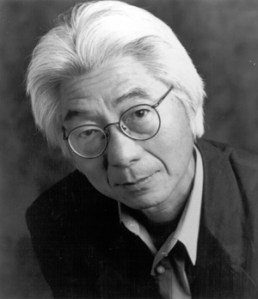
Five years ago this month, one of my most extraordinary and unforgettable undergraduate professors at UCLA — Ron Takaki — died at the age of 70. I am re-posting the tribute I posted at the time. Truly a teacher and scholar for the ages. SMG.
____________________________
Ronald Takaki was a teacher, historian, and extraordinary human being. He was a pioneer in ethnic studies and a faculty member at UCLA and Berkeley. He died at the age of 70 this past May.
Ron was also my teacher and easily one of the 2 -3 greatest and most inspiring professors I had as an undergraduate at the University of California. He is one of the main reasons I chose to spend a lifetime in higher education. Remembering his brilliant and packed lectures, and thinking back to his influence on so many students, I am yet again reminded of the incredible responsibilities, challenges and opportunities we all have as faculty members.
In the spring of 1970, I can’t say I had ever heard the term “globalization.” National, ethnic, religious, and racial borders, especially in a place like California, could not have been more closely guarded. White middle class suburbs — even ones directly adjoining Chicano or African American or Asian neighborhoods — were social and cultural fortresses. Many of us who came directly from those fortresses to UCLA or Berkeley had never been in close proximity to any ethnic diversity. None. It was shameful. We lived in a well armored comfort zone that neither challenged us nor expanded our world view beyond the San Bernardino Freeway.
But there we were as freshmen, looking over the schedule of classes, trying to figure out who was responsible for the typo that had listed some professor with a Japanese surname as the professor for intro to African American history.
When we showed up at class, imagine how baffled we were to see this soft-spoken Asian American professor speaking with a quiet yet furious indignation about the shame of slavery. I vividly remember thinking almost immediately that nothing I thought knew about how the world worked, about the fortresses that were our ethnic and racial and religious enclaves, would ever be the same. Something was happening, and — if we didn’t fully understand all the complex forces — Professor Takaki would be there as a guide to the perplexed. And believe me, in the spring 1970 quarter we needed guiding — Kent State, Cambodia, the Moratorium, and violent confrontations with campus police. Even a fatal shooting on campus. As I look back and calculate the chronology, I am stunned to realize that this gentle and powerful man was then only in his early 30s.
There has never been a time in the intervening 40 years when, seeing someone trying to persuade with bluster and arrogance, I haven’t remembered Ron Takaki in the spring of 1970 and thought: Rage born and nurtured in gentle soul can burn with even greater intensity.
It was an extraordinary time at UCLA, full of fury and passion. Across campus, another great and inspiring professor, Angela Davis, was approaching these issues of inequality from another perspective. And it was a loud time – a time of rage and grievance. How extraordinary it was to have Ron Takaki there amidst the ferment, showing us that even rage could be expressed with civility, that scholarship could reveal layers of barbarity and fuel the kind of anger that can lead to social change.
Sometime later he brought to campus some of the great figures of the infamous WW II relocation of Japanese Americans, people like Fred Korematsu and Joe Grant Masaoka. For many of us in 1969, this shameful episode was still virtually invisible in the exclusionist and triumphal narrative of California history.
He never minimized the conflicts and inequalities and injustices that fueled the growing rage. There was nothing “feel good” about these classes. But simply by explaining these forces, by struggling to help us understand the fires that were starting to burn in urban America, he helped us see that — through understanding and rigorous scholarship — a peaceful future just might be possible.
Really a teacher for the ages.

In the early 1990s, before the advent of the anti-retro viral cocktails that largely rendered HIV a treatable, chronic disease, I found myself at one of the many memorial services that punctuated those years.
In this case, the mourners included a group of children who, much too early in their young lives, were facing the reality of grief, the unforgiving fact of finality.
One of the children, a young girl with a beautiful voice, had never sung in public. But she knew the favorite song of the young man who had been lost, and the only reason she even considered singing My Funny Valentine was that she loved him and wanted to do it for him.
So she found a way.
She would sing the song, but she would turn her back to the assembled. She would share her voice, but not the sight of her tears.
She sang. And it was beautiful. She was beautiful.
It was still several years before the cocktail. The deluge of losses wasn’t close to being over. Courageous activists from Act-Up — the fearless, front line warriors in the battle against apathy and invisibility — were still struggling to wrench affordable drugs from stubborn pharmaceutical companies.
And on some dark days, there was only the voice of a little girl singing.
Addie Mae Collins
Cynthia Wesley
Denise McNair
Carole Robertson

May your hands always be busy
May your feet always be swift
May you have a strong foundation
When the winds of changes shift
Read more: http://www.bobdylan.com/us/songs/forever-young#ixzz2uFnl5CGE

Perhaps you’ve heard about the Broadway ritual of “dimming the lights.”
For over 100 years, and only on very rare occasions, an informal committee of the Broadway League has been marking the passing of members of the acting and directing pantheon by briefly and simultaneously dimming the lights of every Broadway theater.
Robert Simonson, in the September 12, 2010 issue of Playbill, described the ritual:
I’ve thought a lot about his work in the last few days and keep coming back to the idea of peculiarity.
Far too often, rather than relishing uniqueness and idiosyncrasy, we stigmatize difference with words like “peculiar.” We ridicule.
Hoffman, though, could excavate the quintessentially human characteristics in any outsider, revealing that supposedly peculiar characters were actually filled with the same fears and anxieties we all share.
Seeing him work made us more compassionate, more aware of our collective fragility.
Dim the lights.
This morning I was thinking about how quickly our culture anoints heroes. Some unspeakable act occurs and, in a desperate attempt to find a savior, heroes are selected and honored while the accused are demonized. In our infinite patience, we do this so quickly that medals are often presented before we even know exactly what the hero did.
Isn’t this backwards?
Doesn’t the magnitude of an act of courage only become clear with the passage of time, when we can look back and see the historical context in which an act was truly selfless? On the other hand, doesn’t time also occasionally reveal the self-interest and even selfishness that might have been the actual motive for an act initially hailed as courageous?
Here is my favorite scenario for what makes a genuine hero: A modest, decent person does something quintessentially selfless without regard for personal safety. Some people pay attention, but — for a whole host of reasons — the act takes place below the radar of public attention. Maybe the hero isn’t especially desirable. Maybe he or she is a member of a despised group. Or maybe the act itself is such a violation of current values that it is reviled rather than admired.
But then, as time passes, the magnitude of the act – the extent to which it fearlessly transcended the conventions of the moment — slowly becomes clear. And decades later we ask ourselves: How did anyone have the guts to do that?
And so I present my choice for a hero.
The 1955 murder of Emmett Till was a seminal moment in the history of the civil rights movement.Till was a 14 year-old African American from Chicago visiting his family in Mississippi. When he violated the unwritten laws of segregation by talking to a white woman, he was abducted and brutally murdered. Photographs of his open-coffin funeral, revealing an unspeakably savage beating, were widely circulated. Emmett’s mother Mamie became a passionate and eloquent voice for social justice.
My hero, though, is Mose Wright. Mr. Wright was Emmett’s uncle and a witness to the abduction. When two men were accused of the crime, Wright chose to be a witness at the trial and personally identified the two white defendants. At the time, observers at the trial could not recall another example of a black man testifying against a white defendant. Wright moved to Chicago, but once more – ignoring warnings that he would be killed –returned to testify against his nephew’s killers. He never flinched or hesitated.
There’s a lot more to the story. The defendants were acquitted, yet later admitted the killing to Look Magazine for $4000.
And even more, many year later.
Wright died at the age of 83 in 1973.
There is courage. There is heroism. There is selflessness. There is sacrifice. There is near-greatness. There is greatness.
And sometimes, there is a Mose Wright.

We’ve lost one of our most versatile, idiosyncratic and masterful actors.
Philip Seymour Hoffman was only 46 years old and from early reports, it appears that he might have died from a drug overdose.
Of all his work, nothing struck me as more deliciously peculiar, more “unsettling” in the best sense of that word, then his role as Allen in the 1998 Todd Solondz film Happiness.

Hoffman found the humanness and vulnerability in the most peculiar, even disturbing, characters. A master of his craft.
Dim the lights.

Many of you know that one of the most exciting and satisfying aspects of my work at Hunter College is teaching in the M.F.A. Program in Integrated Media Arts in the Department of Film and Media Studies. An excellent description of this graduate program can be found here.
I wanted you to know about a very special event coming up at which you will be able to learn about the exciting work being done by our students and faculty, find out about the graduate training we offer, and learn about the process of applying for admission.
The event will take place on Tuesday, December 17, 2013 from 4:30 to 8:30 PM, and my colleagues and I would love to meet you there and tell you more about what we do. You will also get a chance to meet the two extraordinary people whose energy and enthusiasm has helped propel our MFA into the front rank of new and emerging media graduate programs, Prof. Andrew Lund, Program Director, and Ms. Gayathri Iyer, our Program Coordinator.
Feel free to be in touch if you have any questions.


What a wonderful, appreciative article in the NY Times about the great Bruce Dern.
A master of his craft, he may finally get the recognition he deserves.
And if somehow you missed it when it was first released, treat yourself to Michael Ritchie’s masterpiece Smile, and see Bruce Dern as “Big Bob Freelander,” one of the greatest film performances of the 70s and 80s.
Tell you a secret: If I could only bring one film with me on a month-long camping trip, I’d bring Smile just so I could watch and rewatch Dern as “Big Bob” pontificate about the American dream, optimism, the value of hazing, positive thinking, the profound importance of beauty pageants, and — yes — Elizabeth Taylor.
Bruce Dern.
In my earlier post about the Orson Welles broadcast “War of the Worlds,” I used an image of Grover’s Mill, New Jersey and neglected to credit the photographer, Kendall Whitehouse. I’d like to remedy that, and also refer you to a larger, stunning set of images that Kendall has taken of that small New Jersey town where Martians first “landed” in the 1938 invasion. They were taken on what seems to have been a somewhat overcast day, which makes these photographs of the town that was “invaded” even more striking and dramatic.
I think you also might enjoy a fascinating blog — On Technology and Media — that Kendall does on the Beacon site at the University of Pennsylvania’s Wharton School. A recent post about the role played by Grover’s Mill in this famous broadcast – Return to the Scene of the Martian Invasion – is especially insightful.
Enjoy!

It’s time for one of my extremely rare Peter Finch “Mad as Hell” moments.
By now, we are fully accustomed to the instant experts who immediately appear on cable news after high-profile acts of mass violence. The 24 hour news beast must be fed, and an endless line of charlatans, opportunists and bloviators stand ready to pronounce at a moment’s notice.
Friday, though, during their coverage of the LAX shooting, MSNBC really lurched into “expert-looniness.” Sometime in the early afternoon, they invited an airport security consultant to come on the air and speak about the ongoing events.
At a moment when details were still sketchy, this former El-Al official — who may indeed possess some specialized knowledge — began a long, incoherent rant about alleged deficiencies in our nation’s system of airport security.
My disgust has nothing to do with the substance of what was being discussed. The ranting expert may have made a valid point or two. Or more. Or none. The “conversation” simply wasn’t comprehensible enough to tell.
But I will never accept that it is anything other than grossly irresponsible to begin pronouncing about motives, remedies, causes, and negligence before even 20% of the facts about an incident are in; while some people in the vicinity of the incident are still uncertain about what has happened and might be in locations with televisions broadcasting the rant.
I’m tempted to name this person. His cup overflowed with just the kind of “wisdom” you’d expect from someone with the nerve and thoughtlessness to babble away while an incident is still unfolding.
But because I suspect his appearance was designed to raise the profile of his consulting business, I won’t.
But I will never stop being disgusted with the instant experts for whom a public tragedy becomes a career opportunity.
What was MSNBC thinking when they allowed this opportunist to spout such anxiety-provoking speculation?
I guess that, when you build a 24 hour news hole, they will come.
Disgusting.

With each passing year, it becomes harder to remember one of the most bizarre days — or should I say evenings? — in American history. And given that this evening is the 75th anniversary of the incident that occurred that evening, I wanted my students in particular to know about it in all its rich detail.
With all of the legends and reports about UFOs and extraterrestrials that we have grown up hearing, it becomes harder and harder to believe that on October 30, 1938, in a small field in New Jersey just outside of Princeton, the United States was invaded by aliens from what was probably the planet Mars.
At first, of course, it was unclear what was happening: what seemed to be a vessel of some kind had landed in a field in the small town of Grovers Mill, and townspeople — who began to crowd around it and attempt to figure out exactly what it was — saw only a smoldering hodgepodge of melted metal. Soon after, however, long, menacing flexible metal tubes of some sort, each of which had some kind of an object attached to its end, began to rise out of the smoking hulk and point the in the direction of the gathered crowd. By then, New Jersey state troopers and soldiers from a nearby military base had arrived.
And then chaos ensued.
The rest of what took place on that amazing night is best read in detail, and I have included a link to a page that I think you will find informative. For now, I will only share that the route toward New York City taken by those aliens, through central New Jersey and over the Watchung mountains just a mile from where I now live, and as well as the mayhem that they caused, is absolutely beyond belief to most of us today.
This is a link to the details of that Martian invasion, and this will show you the New York Times headline appearing the next day told the horrible story.
Funny, but even though I study sudden catastrophic violence, I’ve always been glad that I was not alive on that long-ago evening.
Early in William Friedkin’s masterpiece The French Connection, Gene Hackman and Roy Scheider, playing New York City police detectives Doyle and Russo, go for an after-work drink at a New York nightclub that appears to be the Copacabana.
This is the page from the original script describing the interior shot that was originally intended.

However, instead of a chorus line with — in the words used in the script — “lots of tits and ass…,” at some point a decision was made to have The Three Degrees perform Jimmy Webb’s “Everybody Gets to Go to the Moon.” I have no idea when or why this choice was made.
Doyle and Russo, having just come from a back alley roust and beating of a drug suspect, walk out of the dark, through the club’s front door, and into the brightly lit club. The Three Degrees’ electric performance smacks them in the face. The three women are luminous. The performance is tight.
Jimmy Webb’s song was the essence of powerful 70’s pop, and — rather than seeming out of place in a gritty cop film — skillfully establishes just how quickly these two cops move between violence and glitz.
Great film. Great song. And powerful lead singing by the incomparable Sheila Ferguson.

The Times caption today says:
True, but erudite is only part of the story.
Stanley Kauffmann was joyful, compassionate, acutely self-aware, and one heck of a lot of fun to be around.
Most importantly – to me, at least – he was a student and critic of film whose erudition never got in the way of the plain old joy and whimsy with which he approached the art form. He was never ashamed to enjoy hokum, but it did have to be exquisite, thoughtful hokum.
Stanley Kauffman — a sterling model of how to live a full, joy-filled, intellectually-engaged life.
Dim the lights.
Do you know about Improv Everywhere?
I have always revered character actors, bit players, and familiar faces that were — at one time or another — ubiquitous on the screen but rarely known by name. I collect them like mental baseball cards, and my “cast” has always been packed with scores of skilled and memorable performers.
I never know why one in particular pops in at any moment, but I just remembered the great Andy Clyde, whose career began in the era of silent film and ended in network television.
A great comic actor, with exquisite timing and more charm than any one human being deserved.
I’ll be posting the names of others as they come to mind, but Andy is who popped in first.
Married for over 30 years to one of Mack Sennet’s show girls.


Some names we recall from the past are less notable for lofty accomplishments than simply for having always been around; for serving as permanent cultural and chronological markers throughout our lives.
Most of you will not even know the name Cal Worthington.
But to grow up as a young kid in 1950s and 1960s California was to be constantly entertained by Cal Worthington, an owner of numerous car dealerships and early master of personality-driven, novelty car dealership advertising.
As much as anyone, he and fellow California car-hustler Ralph Williams, developed the whole concept of the high pressure car dealer in the 1950s and, if the hustle was extreme, so was the entertainment value and the ever-present gifts and snacks to occupy the kids while Mom and Dad were overpaying for a gas-guzzling Dodge.
I can’t help myself: I remember him fondly. Maybe it was the cotton candy and hot dogs.

Some students of mine from past semesters know that — for a host of personal and other reasons — the mind-boggling injustice of Brandon Hein’s continued imprisonment has concerned me for years.
More information about Brandon’s case can be found here, although the blog is only occasionally updated. Actor Charles Grodin has also devoted significant time and effort to the cause of undoing this injustice. And William Gazecki’s superb documentary Reckless Indifference is still an excellent introduction to Brandon’s case.
We must never, ever, forget Brandon Hein.
And it is time for Governor Jerry Brown to use his executive powers to end Brandon’s imprisonment.
This is truly one of the most incredible, spontaneous musical moments I’ve ever seen. Lenny Kravitz, out for a walk in NOLA, happens upon The Voice of Praise Choir from First Baptist Church in Lewisville, LA., who are singing his song “Fly Away.” He stuns them by joining in and this is what happens.
Kravitz is, as always, elelectrifying, but that’s not news. Watch the skinny kid on lead guitar who seems to channel Clapton, Hendrix, Trucks, Bonamassa, and the rest of the pantheon.
The video comes from the official Lenny Kravitz YouTube site.

Sociologist, criminologist, passionate human rights activist, foe of willful blindness to human suffering and atrocities, and first scholar to fully develop the concept of “moral panic.”
I somehow missed the fact that, in January of this year, British criminologist and sociologist of media and culture Stanley Cohen, passed away. Close to two decades ago, in the acknowledgements section of my dissertation, I thanked Stan profusely for serving as one of my primary mentors, even though I had never met him and, sadly, never did. I did have a brilliant, warm, and infinitely supportive “in person” mentor, the distinguished sociologist, criminologist and student of news media, Mark Fishman.
No exaggeration: Stan’s work on moral panic – those periods of lunacy and fear when society, feeling threatened by some group or individual, irrationally lashes out with rage and hate at a perceived threat — was not only more influential on my own work than that of any other scholar, it was the core, the soul, the very foundation of how I came to understand the ebb and flow of passions, fears, and anxieties in the public sphere.
While I had always planned to make a point of meeting him — it never happened. We did have several brief email exchanges that were indispensable.
The inspiration over the years for a slew of creative and insightful scholars, Cohen’s original work remains the most simply elegant formulation we have ever had explaining why and how, with all the democratic institutions and civil society we’ve created, we are still so prone — and will probably always be prone — to losing our way and going off the rails into thickets of fear, repression, racism, sexism, homophobia, and scapegoating. How sad that Chris Hedges – discussing the same impulse we have to join together in convulsions of loathing — may have been absolutely on target when he suggested that “war is a force that gives us meaning.”
Later in his career, Stan turned to human rights, with a special interest in how tragically easy it is for us to deny the reality of human rights violations and atrocities that are right in our midst. I have placed some memorable quotes from his work below.
It will be strange feeling the loss — really missing — someone I was never able to meet.
“…. any dimming of compassion, any decreased concern about distant others, is just what the individual spirit of the global market wants to encourage. The message is: get real, wise up and toughen up; the lesson is that nothing, nothing after all, can be done about problems like these or people like this.”
“Historical skeletons are put in cupboards because of the political need to be innocent of a troubling recognition; they remain hidden because of the political absence of an inquiring mind.”
“Denial may be neither a matter of telling the truth nor intentionally telling a lie. There seem to be states of mind, or even whole cultures, in which we know and don’t know at the same time.”
– Stanley Cohen in States of Denial: Knowing About Atrocities and Suffering. Polity Press, 2001.
I have been haunted by the story of the legendary 52-hertz whale since I first heard it almost two decades ago.
Burned after the last screw-up in which they apparently announced the Court’s healthcare decision after reading only the first few pages, it looks like CNN has learned a valuable lesson:

David Carr’s masterful “The Night of the Gun: A Reporter Investigates the Darkest Story of His Life” is a must read.
Carr – whose writing I only have known and valued through his New York Times media blog – turns out to have a stunningly original and compelling voice.
And it’s not just the way he turns a phrase.
This is the fully-authentic voice of a real human being; completely without contrivance or hustle or self-consciously ornate prose.
Carr writes with sheer brilliance on the topic of memory and personal narrative. Having struggled to uncover the facts of his own astoundingly messy story, he is incredibly insightful about how we all create artificially coherent and linear life narratives to mask the unsettling confusion and turmoil we would like to forget.
This is the work of a supremely self-aware man who scrupulously avoids artificial tidiness and clarity as he tells the story of a life that has been anything but.
It is almost scary to imagine what might be possible if Carr ever tries a novel. A brew like this of luminous prose and excruciating honesty could be combustible.
I haven’t felt this way since James Ellroy published My Dark Places and set the standard for painful and honest self-exploration.
There may be no logical reason why Carr made it through all the personal horrors he faced “midway in life’s journey,” but he did and emerged to tell a remarkable tale.

Ever gone back to any film, book, or other creative work that completely defined a moment in your life and found that it didn’t come close to passing the test of time?
Sometimes the life moment is so distant and the book or film is so tied to that moment that you simply can’t remember why you felt the way you did.
I’ll never forget going back decades later to the novels of my high school favorite Somerset Maugham and being stunned at just how bad – well, how mediocre – his prose was.
And then there is a film like The Graduate, such a perfect take on my coming of age (everything: the schools, the SoCal lifestyle, my emotions) that I find it even more powerful today. For heaven’s sakes, I even had an Elaine, but no Mrs. Robinson!
My single most disappointing second go-round with a film was when I watched William Dieterle’s Portrait of Jenny several years ago. What had been mystical and impossibly romantic in my mid-teens had “turned” to clap-trap.
Which leads to William Friedkin’s The French Connection. Just saw it for the first time in 30 years.
Still stunning. Still gritty. Still thrilling.
And still one of the greatest examples ever of how a handheld camera in the pre- steadicam era could take you on an almost unbearably riveting journey.
Al Maysles (Salesman) and Haskell Wexler (Medium Cool) were such influential and important players when it came to handheld, and The French Connection used it brilliantly.
What I wanted most to mention, though, is the film’s great contemporary jazz orchestra score by the legendary Don Ellis . I won’t even try to explain it, I lack the musical training and vocabulary, but the frenzied, jumpy score — packed with anxiety and a cacophony of urban noise — was the work of someone who, but for his early death, could easily have been a worthy successor to Bernard Hermann. When it came to almost bizarre time signatures, Ellis staked out almost completely idiosyncratic territory.
He was 44 when he died in 1978.

HBO has confirmed the death today in Rome of actor James Gandolfini.
Gandolfini, 51, whose Emmy-award winning portrayal of Tony Soprano received wide critical and popular acclaim, apparently suffered a massive heart attack.
Thanks to Gandolfini’s masterful and psychologically nuanced performance, as well as incredible writing, what might have simply been another gangster show completely transcended the genre. Tony was first and foremost a fragile and vulnerable human being, with his mob swagger a not very convincing veneer.
Too young.
Sad for an admiring audience. And sad for colleagues who, by all accounts, loved to work with him.
Dim the lights.


 MEDIA AND MAYHEM